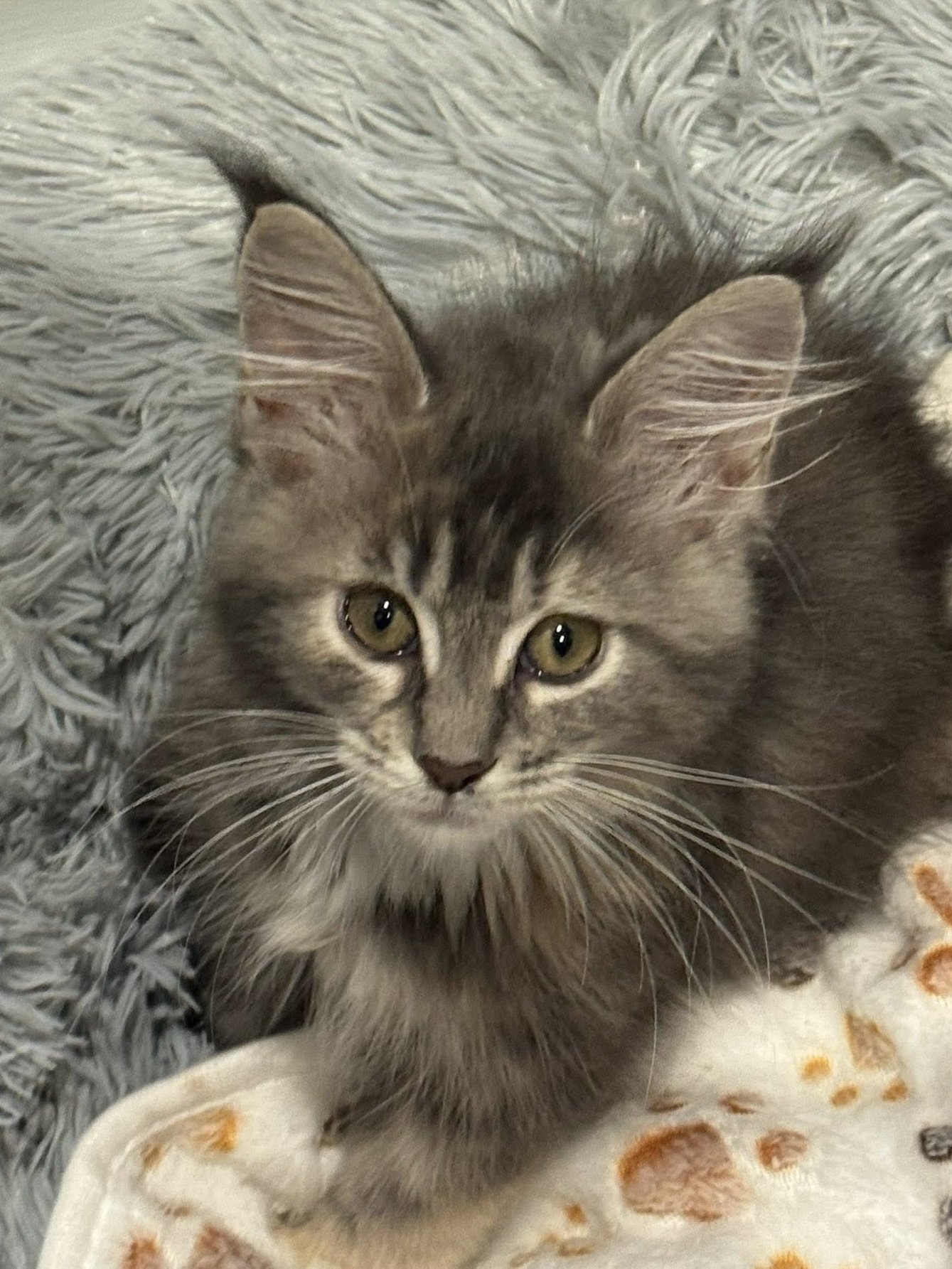
Eepie Mouse was diagnosed with Wet FIP and successfully treated by Dr. Werden of Harmony Hill Animal Hospital in Sterling, VA
Until about 6 years ago, Feline Infectious Peritonitis (FIP) was a death sentence for cats.
Thankfully that is no longer the case and today, with early diagnosis and quick treatment, many cats successfully recover and go on to live normal healthy lives.
Unfortunately, FIP is a complicated disease with varied symptoms so it can be difficult to diagnose. Additionally, familiarity with FIP varies widely among veterinarians.
This article is an introduction to FIP: some of the causes and precursors, the various ways it can present, symptoms to watch out for, treatment options, and how to find a veterinarian who is familiar with the disease.
In the next four articles in this series, we will take a closer look at the specific types of FIP- neurological, ocular, dry and wet.
In short, FIP is caused by a mutation of the feline coronavirus, usually abbreviated FCoV. Nearly every cat in America carries feline coronavirus. It is very similar to the common cold in humans. Normally, FCoV is dormant and the cat exhibits no symptoms. The vast majority of cats with FCoV do not develop FIP, but for the small percentage of cats who do, it is very dangerous.
Any cat can develop FIP, but it occurs more frequently in cats under two years old. Stress may also play a role in whether a susceptible cat develops FIP. For example, after a cat has surgery, it may be more likely to develop FIP.
There are four types of FIP and they all look a little different.
Wet FIP or Effusive FIP causes abnormal fluid to accumulate in body cavities such as around the lungs or in the abdomen. When fluid accumulates around the lungs, symptoms may include a whistling sound when the cat breathes, rapid breathing, and/or difficulty breathing. When fluid collects around the abdomen, the cat may have a visibly swollen belly. Wet FIP progresses relatively quickly to the other types.
Dry, or Non-effusive FIP, does not produce the large fluid accumulations associated with classic wet FIP. Instead, inflammation can affect organs such as the kidneys, liver, intestines, lymph nodes or other tissues and enlarge them. Symptoms depend on which organs are involved which makes Dry FIP especially difficult to recognize.
Ocular FIP involves the eyes, producing inflammation and visible changes in the eye. Signs can include inflammation inside the eye, cloudiness, changes in iris appearance or color, abnormal pupils, blood or inflammatory material within the eye and vision problems.
Neurological FIP affects the brain or spinal cord. Cats with this type of FIP can develop neurological symptoms such as difficulty walking, poor coordination, tremors, seizures, weakness, abnormal eye movements, changes in behavior or other neurological abnormalities.
Because these types of FIP are not four separate diseases, but one disease that can present in four different ways, sometimes symptoms of one type of FIP can cross over into other types of FIP.
One of the biggest challenges with FIP is that its earliest symptoms can look like dozens of other illnesses.
Common early signs include:
· Loss of appetite or decreased appetite
· Weight loss
· Failure to gain weight normally in a kitten
· Lethargy
· Fever, particularly a persistent or recurring fever
· Poor coat or generally "unthrifty" appearance
· Enlarged lymph nodes
· Pale gums
· Jaundice
· Bruxism (grinding teeth)
There is no simple FIP test that can be run on every sick cat and provide an unquestionable yes-or-no answer. There is a test for FIP, but it is unreliable. I once heard a vet tell me that the FIP test causes more deaths than not testing at all because false negatives are so common.
Veterinarians therefore build a diagnosis using multiple pieces of evidence.
Bloodwork can provide important clues- specifically the albumin-to-globulin ratio or A:G ratio. When the A:G ratio is low, it is a very good indicator that a cat may have FIP.
Imaging such as ultrasound may reveal fluid, enlarged lymph nodes or abnormalities affecting organs. When fluid is present, analyzing and testing that fluid can be particularly valuable. In other cases, veterinarians may test tissue samples or other material depending upon the cat's symptoms.
The American Association of Feline Practitioners and EveryCat Health Foundation describe this approach as building the diagnosis “brick by brick”.
Always defer to your veterinarian, but for the sake of this article, I will share my approach to FIP:
-I ensure all my cats are tested for FeLV and FIV. Those two diseases can sometimes look like FIP, and when a cat gets sick, I can automatically rule them out as possibilities because all of my cats have been tested.
-I get bloodwork done as soon as possible. In my experience, a low A:G ratio is one of the best indicators that I am dealing with FIP.
-I keep FIP medication on hand and begin treatment as soon as I believe FIP is the problem. FIP medication does not cause harm when it is given to a cat who does not have FIP. That said, a cat’s prognosis is directly related to how soon treatment begins. Improvement is seen in about 48 hours after starting medication if a cat has FIP. Improvement in symptoms within 48 hours of beginning treatment is the very best indicator that the problem is FIP.
Until fairly recently, there was no treatment for FIP.
Recently, GS-441524 was found to inhibit viral replication and was determined to be an effective treatment for FIP.
Unfortunately, even knowing this, there was one enormous problem for American cat owners:
They couldn't obtain it through the normal veterinary prescription system because it was not approved for use in cats.
For several years, owners desperate to save cats with FIP turned to an underground network of online suppliers and volunteer groups. Cats were being successfully treated, but owners frequently had to obtain unregulated medication outside the veterinary system.
Finally, in June 2024, compounded oral GS-441524 became available to U.S. veterinarians through a veterinary compounding pharmacy. That said, GS-441524 is not an FDA-approved drug for FIP. The FDA has only established an enforcement discretion policy that allows veterinarians to prescribe appropriately compounded GS-441524 under specified circumstances.
It’s great that veterinarians can prescribe reliable, compounded medication and oversee treatment, however, because treatment options have changed so quickly, experience among veterinarians regarding FIP varies greatly. I have seen this first-hand, and thankfully I have found an FIP expert in Northern Virginia- Dr. Werden at Harmony Hill Animal Hospital in Sterling, VA has an incredible track record healing cats with FIP. I have worked closely with her several times and cannot recommend her highly enough.
Even veterinarians who know that FIP can now be treated may not yet have personally managed many cases. If FIP is suspected, it is completely reasonable to ask if your vet is comfortable diagnosing it and treating it with GS-441524. The vet I normally see is wonderful and I consider her to be above reproach regarding cat health care, but she told me that this is not her area of expertise, and she is the one who recommended Dr. Werden to me. I recommend having a frank conversation with your vet the next time you see them and ask them about their experience with FIP. If they don’t have much, see if they recommend someone who does. You do not want to be dealing with a suspected FIP emergency and have to find a new vet to help you at the same time.
FIP is a serious disease. Cats can become critically ill, diagnosis can be complicated, and treatment can be tricky to get, but it is so important that cat owners know there is hope.
There are vets still telling people there is no hope for their cats with FIP and they should be put down. Recently I heard of a vet who told an owner their cat would need a blood transfusion before undergoing treatment and recommended the owner put their cat to sleep. This is not true. I know of cats who were so sick that they couldn’t take the oral medication and needed the first several doses given to them by injection and they made a full recovery. As long as a cat is alive, they can be treated. The GS medication is extremely effective.
This is the first article in our FIP series. Next, we'll look more closely at the different ways FIP can present, including the symptoms, diagnostic clues and treatment considerations unique to each type of FIP.
The more cat owners — and especially those of us who live or work with many cats — understand about FIP, the better equipped we are to recognize when something isn't right and get a sick cat appropriate veterinary care quickly.
I am not a veterinarian. I am sharing information I’ve gained through research, talking with vets, and personal experience. I am more than happy to talk with you if you ever suspect your cat has FIP and help you find the resources you need to save your cat.
This article is intended for educational purposes and is not a substitute for veterinary diagnosis or treatment. FIP treatment protocols continue to evolve, so treatment decisions should be made with a veterinarian using current veterinary guidance.
